How to Read Your Credit Report Like an Auditor (and Catch the Errors That Cost You Points)

Read the transcript
Nobody proofreads your credit report. You're the auditor. In one federal study, one in five people found an error on at least one report. (On screen: Source: FTC report to Congress on credit report accuracy.) Your three reports won't match. So check all five sections, in order. This collection was settled, but it still shows a balance. Its first late date was moved, which restarts the clock. Same debt, counted twice. Keep a workpaper, one row per account. Negative isn't the same as wrong. Only real errors are disputable. Be first in line. Join the waitlist.
When the Federal Trade Commission ran its landmark accuracy study, 1 in 5 consumers found an error on at least one of their three bureau reports. About 5% found errors serious enough to change the price of credit they'd be offered. And the problem hasn't shrunk: in 2025, Americans filed roughly 5.8 million complaints about credit and consumer reporting with the Consumer Financial Protection Bureau — about 88% of all complaints the agency received, more than double the year before. The #1 issue was incorrect information on a report.
So treat your credit report the way an auditor treats a financial statement: guilty until proven accurate. Nobody at the bureaus proofreads your file. The lender that furnished a wrong balance won't catch it. You are the only auditor your file will ever get.
This guide shows you how to pull all three reports free, what every section means, the 14 error patterns that actually move scores, what evidence proves each one, and how to tell a real error from an accurate negative that needs a different fix.
Step One: Get All Three Reports (Free, Weekly, Forever)
Go to AnnualCreditReport.com — the federally authorized source — and download your TransUnion, Equifax, and Experian reports. What started as one free report per bureau per year became free weekly reports during the pandemic, and that change is now permanent. You never need to pay for your own credit reports.
Download all three as PDFs and save them with the date in the filename — you'll want the "before" copies if you dispute anything.
Why your three reports don't match
Reporting to credit bureaus is voluntary. No law forces a lender or collector to send your account data to all three bureaus — or to any of them. So each bureau holds a different, incomplete picture of you.
A current example: Affirm, the buy-now-pay-later lender, reports all of its loans to Experian (since April 2025) and TransUnion (since May 2025) — but not Equifax. Klarna and Afterpay still largely don't report their pay-in-4 plans at all. Three BNPL accounts can make you look completely different across your three files.
The same goes for errors. A collector might report a bogus balance to two bureaus and skip the third; a mixed file can exist at one bureau only. When a mortgage lender pulls all three reports (a "tri-merge"), the error you never saw becomes the reason your rate goes up. That's why the audit below is a three-pass job — one report is a sample; three are the full population.
The Anatomy of a Credit Report: Five Sections
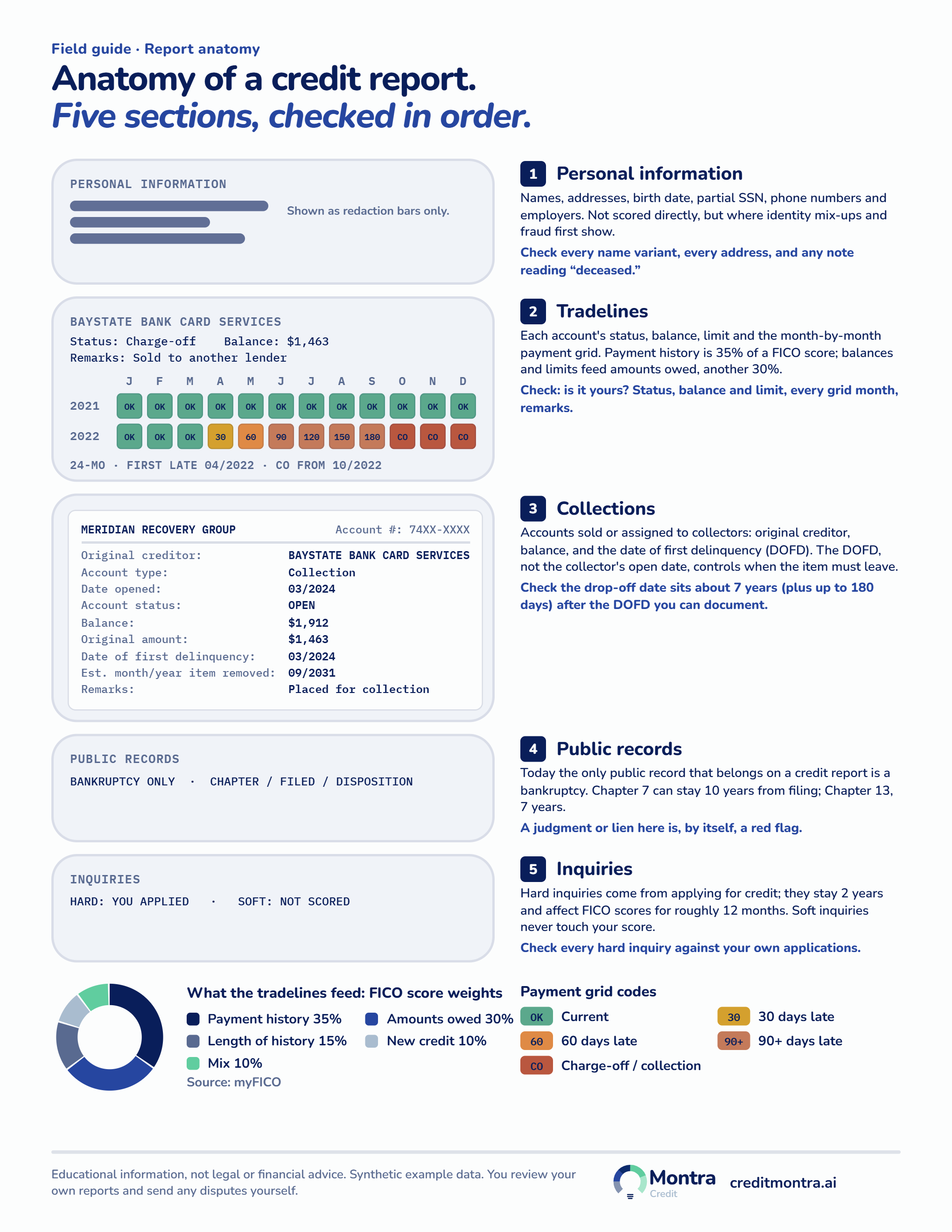
Every bureau formats its report differently, but the contents break into the same five sections. Learn what belongs in each, and anything that doesn't belong starts to glow.
Exhibit A Synthetic example
Five sections, one report
A specimen credit report split into its five sections (personal information, tradelines, collections, public records and inquiries), with a ring showing the FICO 8 factor weights and the section each factor is read from.
1Personal informationNot scored
- Names
- NADIA R THOMPSON / NADIA THOMPSON
- Addresses
- COLUMBUS OH · DAYTON OH
- SSN (last 4)
- ●●●●
- Birth year
- ●●●●
None of this is scored directly, but it's where identity mix-ups and fraud first show themselves.
2Tradelines
- Creditor
- VISA ...4402
- Status
- Open
- Balance / limit
- $340 / $5,000
- Payment grid
- OK OK OK OK OK OK
The heart of the report. Payment history is 35% of a FICO score and amounts owed another 30%: two-thirds of your score lives in this section.
3Collections
- Collector
- MERIDIAN RECOVERY GROUP
- Original creditor
- BAYSTATE BANK CARD SERVICES
- Date of first delinquency
- 03/2024
Each entry should name the original creditor and the date of first delinquency (DOFD). The DOFD, not the collector's open date, controls when the item must leave your report.
4Public records
- Bankruptcies
- None reported
Today, the only public record that belongs on a credit report is a bankruptcy. A judgment or lien appearing here is, by itself, a red flag.
5Inquiries
- Hard inquiries
- 2 in the last 24 months
- Soft inquiries
- Visible only to you
Hard inquiries stay on your report for 2 years and affect your FICO score for roughly 12 months. Soft inquiries never touch your score.
FICO 8 factor weights
- Payment history(Tradelines)35%
- Amounts owed(Tradelines)30%
- Length of history(Tradelines)15%
- New credit(Inquiries)10%
- Credit mix(Tradelines)10%
Payment history and amounts owed are read from your tradelines. That's two-thirds of the score in one section.
Source: myFICO, What's in my FICO Scores
Personal information
Your names (including variants and misspellings the bureaus have collected), current and former addresses, birth date, partial Social Security number, phone numbers, and employers. None of this is scored directly — but it's where identity mix-ups and fraud first show themselves.
Tradelines: your open and closed accounts
The heart of the report. Each card, loan, and mortgage gets its own block: creditor name, partial account number, date opened, status, balance, credit limit or original loan amount, highest balance ever reported, and the payment-history grid — a month-by-month record marked "OK" for on-time months and 30/60/90/120 or "CO" (charge-off) for delinquent ones. Codes vary by bureau; the legend is on the report.
That grid is the raw material for payment history — 35% of a FICO score, the biggest single factor. Balances and limits feed "amounts owed," another 30%. Two-thirds of your score lives in this section.
Exhibit B Synthetic example
Decode a payment-history grid
Twenty-four months of a card's payment-history grid: on time (OK) from 01/2021 through 03/2022, then 30, 60, 90, 120, 150 and 180 days late from 04/2022 to 09/2022, and charged off (CO) from 10/2022.
BAYSTATE BANK CARD SERVICES
01/2021 to 03/2022: OK (Current). 04/2022: 30 (30 days late). 05/2022: 60 (60 days late). 06/2022: 90 (90+ days late). 07/2022: 120 (90+ days late). 08/2022: 150 (90+ days late). 09/2022: 180 (90+ days late). 10/2022 to 12/2022: CO (Charge-off / collection).
- Current
- 30 days late
- 60 days late
- 90+ days late
- Charge-off / collection
- 04/2022: First 30-day late: the date of first delinquency (DOFD).
- 10/2022: Charged off (CO).
Codes vary by bureau; the legend is on the report.
Why the first late matters: the 7-year clockCollections
Accounts sold or assigned to collection agencies. Each entry should name the original creditor, the balance claimed, the date the collector opened its file, and — critically — the date of first delinquency (DOFD): the date you first fell behind with the original creditor and never caught up. The DOFD, not the collector's open date, controls when the item must leave your report.
Public records: bankruptcies only
Today, the only public record that belongs on a credit report is a bankruptcy. Civil judgments and tax liens were purged from all three bureaus' files in 2017–2018 under the National Consumer Assistance Plan, a reform agreement the bureaus reached with state attorneys general, because those records couldn't be reliably matched to the right people. The CFPB later studied the removal and found little effect on most scores — but the audit rule is simple: a judgment or lien appearing as a public record today is, by itself, a red flag.
Chapter 7 bankruptcies can stay for 10 years from the filing date; Chapter 13 for 7 years.
Inquiries: hard vs. soft
Hard inquiries happen when you apply for credit. They're visible to other lenders, stay on your report for 2 years, and affect your FICO score for roughly 12 months. Multiple auto, mortgage, or student loan pulls inside a short rate-shopping window are typically counted as one for scoring.
Soft inquiries — checking your own report, prequalification offers, account reviews by existing lenders, insurance checks — are visible only to you and never touch your score. Only the hard list matters for your audit.
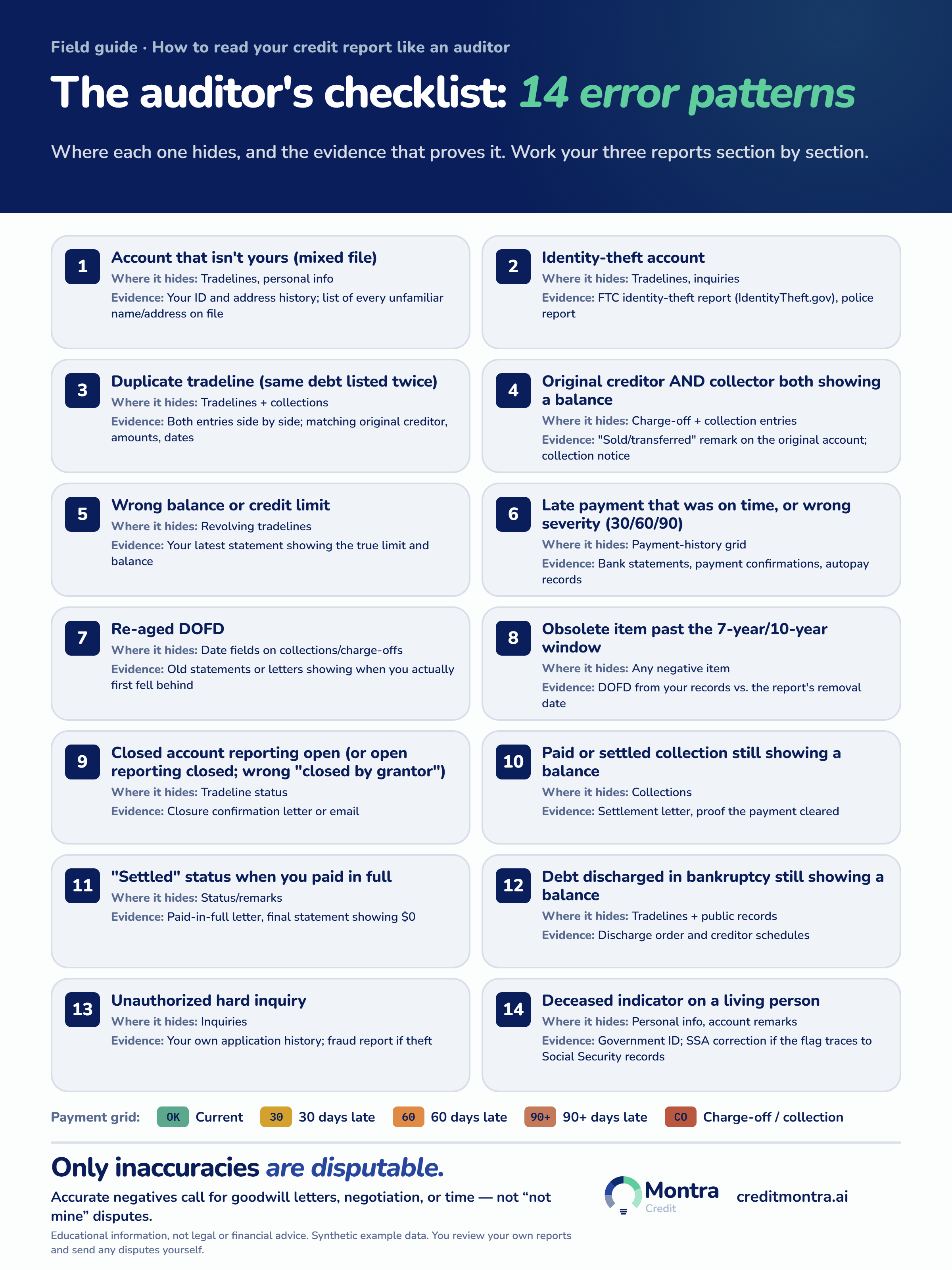
The Auditor's Checklist: 14 Errors That Actually Move Scores
Most guides say "look for errors" and stop. Here's the actual catalog — the patterns that recur in CFPB complaints, FCRA lawsuits, and repair forums, and do real score damage. Scan the table, then work section by section.
Exhibit C Synthetic example
The 14 error patterns
The 14 credit report error patterns that do most of the damage, with where each hides, why it costs you, and the evidence that proves it. Filter by report section.
| # | Error pattern | Where it hides | Why it costs you | Evidence that proves it |
|---|---|---|---|---|
| 1 | Account that isn't yours (mixed file) | Tradelines, personal info | Someone else's balances and lates score as yours | Your ID and address history; list of every unfamiliar name/address on file |
| 2 | Identity-theft account | Tradelines, inquiries | Fraudulent unpaid debt plus hard pulls in your name | FTC identity-theft report (IdentityTheft.gov), police report |
| 3 | Duplicate tradeline (same debt listed twice) | Tradelines + collections | One debt counted twice inflates amounts owed | Both entries side by side; matching original creditor, amounts, dates |
| 4 | Original creditor AND collector both showing a balanceSee it in the worked example | Charge-off + collection entries | Same dollars owed twice on paper | "Sold/transferred" remark on the original account; collection notice |
| 5 | Wrong balance or credit limitTry the utilization math | Revolving tradelines | Distorts utilization — 30% of your FICO score | Your latest statement showing the true limit and balance |
| 6 | Late payment that was on time, or wrong severity (30/60/90)Decode a payment grid | Payment-history grid | Payment history is 35% of your score; a 90 hits harder than a 30 | Bank statements, payment confirmations, autopay records |
| 7 | Re-aged DOFDSee it in the worked example | Date fields on collections/charge-offs | Illegally restarts the 7-year clock | Old statements or letters showing when you actually first fell behind |
| 8 | Obsolete item past the 7-year/10-year window | Any negative item | Should already be gone; still dragging your score | DOFD from your records vs. the report's removal date |
| 9 | Closed account reporting open (or open reporting closed; wrong "closed by grantor") | Tradeline status | Wrong utilization math; mislabeled closures look bad in manual review | Closure confirmation letter or email |
| 10 | Paid or settled collection still showing a balanceSee it in the worked example | Collections | Newer score models ignore $0 collections — a phantom balance keeps hurting you | Settlement letter, proof the payment cleared |
| 11 | "Settled" status when you paid in full | Status/remarks | "Settled" tells lenders you paid less than you owed | Paid-in-full letter, final statement showing $0 |
| 12 | Debt discharged in bankruptcy still showing a balance | Tradelines + public records | Discharged debts must show $0 and "included in bankruptcy" | Discharge order and creditor schedules |
| 13 | Unauthorized hard inquiry | Inquiries | Modest score dent; major identity-theft warning sign | Your own application history; fraud report if theft |
| 14 | Deceased indicator on a living person | Personal info, account remarks | The file can become unscorable — no score at all | Government ID; SSA correction if the flag traces to Social Security records |
Now walk your report top to bottom. For each section: what to check, why it hurts, and what evidence to gather.
Auditing personal information
Check: every name variant (watch Jr./Sr./II mix-ups), every address, your birth date, the last four of your SSN, employers, and any note reading "deceased."
Why it hurts. An address you never lived at or a name that isn't quite yours is the classic fingerprint of a mixed file — the bureau has merged another person's data into yours, often a relative with the same name or a stranger with a similar SSN. The CFPB has publicly called out sloppy file-matching practices, including matching records by name alone. If a stranger's accounts are scoring as yours, everything downstream is contaminated.
A deceased indicator is worse than any late payment: scoring models generally can't produce a score for a file flagged as deceased, so instead of a low score you get no score, and applications start auto-declining. It usually appears after a joint account holder dies and the furnisher flags the wrong person. Look for it in the personal-information header and in individual account remarks.
Evidence to gather: your government ID and a utility bill or lease for your real addresses. For a deceased flag, dispute with each bureau showing it; if the error traces to Social Security Administration records, correct it with SSA directly.
Auditing tradelines (open and closed accounts)
This is the longest pass. For every account block, verify five things against your own records:
- Is it yours? Unfamiliar accounts are either mixed-file contamination, identity theft (pattern #2 — if so, file at IdentityTheft.gov, which unlocks a faster FCRA blocking path), or a store card reporting under its issuing bank's name (see "What's not an error" below before you panic).
- Status and who closed it. A card you paid off and closed that still reports open with a balance keeps feeding wrong numbers into your utilization. The reverse hurts too: an open card wrongly reported closed drops its limit out of your available-credit math, so the same balances look like a bigger share of your limits. And if you closed the account but it says "closed by credit grantor," that's inaccurate — scoring models generally don't care who closed it, but a human underwriter might, and you're entitled to accuracy either way.
- Balance and credit limit. A wrong limit quietly savages utilization, which drives most of the 30% "amounts owed" slice of your score. Example: a $3,000 balance on a $10,000-limit card is 30% utilization; if the bureau has the limit as $5,000, the identical balance reads as 60%. See how utilization works and the AZEO method.
Exhibit D Synthetic example
One wrong limit, twice the utilization
A $3,000 balance on a $10,000-limit card is 30% utilization. If the bureau has the limit as $5,000, the identical balance reads as 60%.
Limit on your statement
$3,000 on a $10,000 limit
Matches your statement
Limit the bureau reports
$3,000 on a $5,000 limit
Wrong limit on the report
A wrong limit quietly savages utilization, which drives most of the 30% "amounts owed" slice of your score.
- The payment grid, month by month. Compare every 30/60/90 against your bank records. Two distinct errors hide here: a late that never happened, and a real late reported at the wrong severity — a payment 32 days late reported as 60 or 90 days. Severity escalates the damage, so downgrading a wrong 90 to the true 30 is worth real points. If the late is accurate, disputing won't fix it — a goodwill letter might.
- Statuses and remarks. "Settled" means you paid less than the full balance; if you actually paid in full, that word is costing you in manual reviews — dispute it with your paid-in-full letter. On charge-offs, check for a "sold/transferred" remark: once a debt is sold, the original creditor's tradeline should report a $0 balance. If it still shows the full balance and a collector reports it too, the same debt is counted twice (pattern #4 — charge-offs explained covers this life cycle). And if you went through bankruptcy, every discharged account must show $0 owed with an "included in bankruptcy" notation — a discharged debt still showing a balance is one of the most consequential errors on this list.
Evidence to gather: current statements (for balances and limits), bank statements and payment confirmations (for the grid), closure emails or letters, paid-in-full or settlement letters, and your bankruptcy discharge order with the schedule of creditors.
Auditing collections
Check: the original creditor's name, the balance, the account status, the date of first delinquency, and the projected removal date.
Why it hurts. Collections are heavy negatives on their own, but the errors multiply the damage:
- Paid or settled collections still showing a balance. Many newer scoring models ignore collections with a $0 balance entirely, so a phantom balance can cost you points you've already paid to be rid of.
- Resold-debt chains. Debts get sold from collector to collector. Only the current owner should report a balance; every prior collector should show $0/transferred or fall off. Two collectors both claiming the same balance is pattern #3.
- Re-aging. The 7-year clock runs from the DOFD with the original creditor — under FCRA §605(c) (15 U.S.C. §1681c(c)), a collection must leave your report no later than 7 years plus 180 days from that date. Selling the debt doesn't reset the DOFD, and neither does paying. A collector listing its own file-open date as the DOFD — making the debt look years younger — is re-aging, and it's illegal. Here's how the 7-year clock and DOFD really work.
- Obsolete items. Anything past its window should be gone — no dispute artistry required, just a demand for removal as obsolete.
- Medical collections have special rules. Under reforms the three bureaus adopted voluntarily (which stand even after a broader CFPB medical-debt rule was vacated in July 2025): paid medical collections are removed entirely, unpaid ones under $500 aren't reported, and nothing appears until the debt is at least a year past due. See any of the three? Flag it.
Exhibit E Synthetic example
The 7-year clock, started twice
Two reporting clocks for the same debt. Started from the collector's file-open date, 03/2024, the clock runs to 09/2031, matching the listed removal date. Started from the real first late with the original creditor, 04/2022, it runs out in late 2029: roughly two years earlier.
7 years plus 180 days from the DOFDFCRA §605(c), 15 U.S.C. §1681c(c)
As reported
- Clock starts:
- 03/2024, the collector's own file-open date
- Must leave by:
- 09/2031
As it should run
- Clock starts:
- 04/2022, your first late with Baystate
- Must leave by:
- late 2029
7 years plus up to 180 days from 04/2022 lands in late 2029, yet the listed removal date is 09/2031: roughly two years too long. That's re-aging.
If a collection is accurate and unpaid, disputing isn't the play — negotiation is. See the guide to collections and pay-for-delete.
Evidence to gather: settlement or payment letters, bank records showing cleared payments, any old statement or collection notice that pins down when you first fell behind, and debt-validation responses.
Auditing public records
Check: only bankruptcies should appear. Verify the chapter (7 vs. 13), the filing date, and the disposition (discharged vs. dismissed). Removal runs 10 years from filing for Chapter 7, 7 years for Chapter 13.
Why it hurts. A Chapter 13 mislabeled as Chapter 7 sticks around three years longer. A civil judgment or tax lien appearing in this section shouldn't be there at all — the bureaus removed those categories in 2017–2018. And the bankruptcy section is your anchor for pattern #12: pull the list of discharged accounts from your schedules and confirm each one's tradeline shows $0.
Evidence to gather: your discharge order, petition, and creditor schedules. Court records are the trump card here — bureaus can't out-argue a federal docket.
Auditing inquiries
Check: every hard inquiry against your memory and paperwork. Did you actually apply? Clusters of auto-lender pulls from one dealership visit are normal (and deduplicated for scoring); lone pulls from companies you've never contacted are not.
Why it hurts. New credit is only 10% of a FICO score, and each inquiry stops affecting it after about a year — so inquiries are the smallest lever on this list. The real reason to audit them: a hard pull you never authorized is often the first visible trace of identity theft. Treat it as smoke and go look for the fire in your tradelines.
Evidence to gather: your own application records. If the inquiry is fraudulent, an identity-theft report at IdentityTheft.gov, then disputes to the bureau and the company that pulled.
Bureau-by-Bureau Quirks (and a Tracking Sheet That Keeps You Sane)
The three reports hold the same kinds of data under different labels. Three quirks matter most:
Where the removal date hides. Labels shift as bureaus redesign their reports, but as of recent formats (community-reported on the myFICO forums):
| Bureau | Where to find the drop-off date |
|---|---|
| TransUnion | "Estimated month and year that this item will be removed," inside the account block |
| Experian | "On record until" date on each negative item |
| Equifax | Often shows the date of first delinquency on collections rather than a computed removal date — add 7 years (plus up to 180 days for collections) yourself |
Whatever the label, audit the math: does the removal date sit roughly 7 years (plus up to 180 days) after the DOFD you can document? If it's later, someone re-aged the debt.
Balance timing differs. Lenders report on their own cycles and bureaus snapshot on different days. A $340 balance at TransUnion versus $402 at Equifax is usually timing, not an error. A $0 versus $1,900 gap is an error.
Same account, different disguise. Account numbers are masked differently at each bureau, and store cards report under their issuing bank's name. Match accounts across bureaus by opened date, limit or original amount, and creditor family — not by the masked number.
The cross-comparison method
Auditors don't trust memory; they build workpapers. Make one row per account across all three reports and differences jump out — a bureau disagreeing with its two siblings about the same account is itself a lead. Copy this template:
Exhibit F Synthetic example
Your cross-bureau workpaper
A comparison sheet with one row per account across TransUnion, Equifax, Experian and your own records. Example rows: a Visa card that Experian reports with a $2,500 limit instead of $5,000, and a Meridian collection with the wrong balance and DOFD at TransUnion and Experian and not reported at Equifax.
| Account / Item | TransUnion says | Equifax says | Experian says | My records say | Error? | Evidence I have | Next step |
|---|---|---|---|---|---|---|---|
| Visa ...4402 | Open, $340, limit $5,000 | Open, $402, limit $5,000Timing | Open, $340, limit $2,500Mismatch | Limit $5,000 per statement | Experian limit wrong | June statement PDF | Dispute w/ Experian |
| Collection — Meridian | Balance $1,912, DOFD 03/2024Mismatch | Not reportedNot reported | Balance $1,912, DOFD 03/2024Mismatch | Settled 05/2026; first late 04/2022 | Balance + DOFD wrong | Settlement letter, old statements | Dispute w/ TU + EX |
- MismatchDisagrees with your records: a lead worth disputing, with your evidence attached.
- TimingLenders report on their own cycles and bureaus snapshot on different days, so a small balance difference is usually timing, not an error.
- Not reportedReporting to credit bureaus is voluntary, so an account missing from one file isn't an error by itself.
Date the sheet, keep it with your saved PDFs, and update it after every dispute round.
What's NOT an Error (Read This Before You Dispute)
An auditor's job is accuracy, not wish fulfillment. Some things look wrong but aren't:
Exhibit G Synthetic example
Error, or not?
Eight things that can look wrong on a credit report. Six are not errors: a store card under a bank's name, a high balance larger than your current balance, authorized-user accounts, a closed account in good standing, small cross-bureau balance differences, and accurate negatives. Two are errors: $0 at one bureau and $1,900 at another for the same account, and a civil judgment listed under public records.
Make your call on each, then check.
A store card under a bank's name
Not an errorYour retail card likely reports under the issuing bank (a name you may not recognize). Match the opened date and limit before crying fraud.
$0 at one bureau, $1,900 at another, for the same account
Error: dispute itTiming explains small differences, not this one. A $0 versus $1,900 gap is an error.
"High balance" larger than your current balance
Not an errorThat field records the most you ever owed on the account. It's historical, not current.
An authorized-user account
Not an errorIf someone added you to their card, it legitimately appears on your report; you can usually ask the issuer to remove you if it hurts more than helps.
A civil judgment listed under public records
Error: dispute itCivil judgments and tax liens were purged from all three bureaus' files in 2017–2018. A judgment or lien appearing as a public record today is, by itself, a red flag.
A closed account in good standing still reporting
Not an errorPositive closed accounts can stay for years — and that's good for you. Leave them alone.
Small cross-bureau balance differences
Not an errorLenders report on their own cycles and bureaus snapshot on different days. Small gaps are usually timing, not an error.
A late payment that really happened
Not an errorAccurate negatives — a late payment that really happened, a collection you really owe, a charge-off that matches your records — are not disputable as "inaccurate," because they aren't.
For accurate negatives, the honest paths are different tools: dispute only genuine inaccuracies using the step-by-step FCRA dispute playbook; ask for mercy on real late payments with goodwill letters; negotiate real collections, including pay-for-delete where possible; and let the clock work — every negative has a hard expiration date.
One warning, because credit-sweep marketing pushes the opposite: do not dispute accurate items as "not mine." Under FCRA §611 (15 U.S.C. §1681i), bureaus can deem disputes frivolous and stop investigating — blanket false disputes are exactly what earns that label, and a "removed" accurate item can reappear when the furnisher re-reports it. If a company promises to sweep real debts off your file, that's a well-documented scam pattern.
And if your problem is an empty file rather than an inaccurate one, auditing won't add points — building credit from scratch is the guide you want.
Worked Example: Auditing One Collection Tradeline
This is a constructed example with plausible numbers, not a real account. Three errors are planted in it.
Exhibit H Synthetic example
Three catches in one collection
A constructed Meridian Recovery Group collection and the original creditor's Baystate tradeline, audited against your records. Catch 1: a collection settled in May 2026 still shows a $1,912 balance (pattern #10). Catch 2: the DOFD reads 03/2024, but the first late was 04/2022, so the removal date is roughly two years too late (pattern #7). Catch 3: Baystate still reports $1,463 after selling the debt while Meridian reports $1,912, about $3,375 owed on paper (pattern #4).
What you know: Your Baystate Bank card fell behind in April 2022 and was eventually charged off and sold. In May 2026 you settled with the collector, Meridian Recovery Group, for $900, and you have the letter confirming settlement in full.
MERIDIAN RECOVERY GROUP
Account #: 74XX-XXXX
- Original creditor
- BAYSTATE BANK CARD SERVICES
- Account type
- Collection
- Date opened
- 03/20242
- Account status
- OPEN1
- Balance
- $1,91213
- Original amount
- $1,463
- Date of first delinquency
- 03/20242
- Est. month/year item removed
- 09/20312
- Remarks
- Placed for collection
BAYSTATE BANK CARD SERVICES
Same report, the original creditor's tradeline
- Status
- Charge-off
- Balance
- $1,4633
- Remarks
- Sold to another lender3
- Grid
- First 30-day late 04/2022, CO from 10/20222
Your records
- Settlement letter, May 2026
- Bank statement: $900 payment cleared
- A 2022 Baystate statement
- Collection notice naming Baystate
Catch 1: The balance
Status "OPEN," balance $1,912. But you settled this account in May 2026 and hold the letter. A settled collection must report $0 with a settled status — and because newer scoring models skip $0-balance collections, this phantom $1,912 may be costing points every month.
Evidence: Settlement letter plus the bank statement showing the $900 payment cleared.
Catch 2: The DOFD
The listed date of first delinquency, 03/2024, is suspiciously identical to the date Meridian opened its file. The DOFD should be the date you first fell behind with Baystate — and Baystate's own grid on the same report says that was 04/2022.
Count forward: 7 years plus up to 180 days from 04/2022 lands in late 2029, yet the listed removal date is 09/2031 — roughly two years too long. That's re-aging.
Evidence: The Baystate grid itself, plus any 2022 statement — the report contradicts itself, an auditor's favorite kind of proof.
Catch 3: The double balance
Baystate says "Sold to another lender" yet still reports $1,463 while Meridian reports $1,912 on the same debt. Once sold, the original creditor's balance must drop to $0.
As reported, your file shows about $3,375 owed on a debt you already settled.
Evidence: The "sold" remark, the collection notice naming Baystate, and your settlement letter.
Three errors, one account block — each found by comparing the report against records you already have.
Three errors, one account block — each found by comparing the report against records you already have. That's the whole method. From here, each catch becomes a dispute with evidence attached; the FCRA dispute playbook covers how to file and what the bureaus' 30-day investigation deadline requires.
Field kit
Print the checklist, keep the anatomy page beside your reports, and track every account on the workpaper.
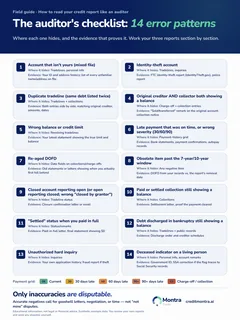
Field guide: 14 error patterns
One page with all 14 patterns, where each hides and the evidence that proves it.
PDF · Letter · 83 KB
Download PDF: Field guide: 14 error patterns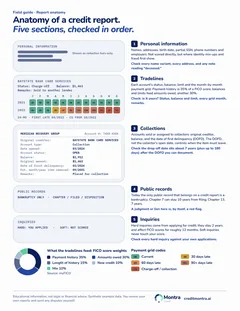
Report anatomy
The five sections of a credit report on one page: what belongs in each and what to check.
PDF · Letter · 113 KB
Download PDF: Report anatomyAlso:Image PNG (568 KB)
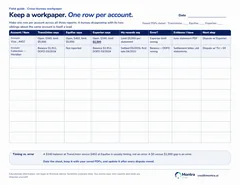
Cross-bureau workpaper
A printable tracking sheet: one row per account across all three reports and your own records.
PDF · Letter, landscape · 62 KB
Download PDF: Cross-bureau workpaperAlso:A4 PDF (62 KB)
What the Forums Get Right (and Wrong)
Communities like r/CRedit and the myFICO forums have processed thousands of real dispute stories. Their collective wisdom is useful — with traps. (These are community-reported practices, not guarantees.)
What they get right:
- Pull all three reports; never audit from an app alone. Credit Karma shows TransUnion and Equifax data with VantageScore 3 — no Experian, and not the FICO 8 most lenders use. Free apps are fine as tripwires, useless as audit evidence.
- Screenshot and save everything, with dates. Reports change — the tradeline you dispute today may quietly morph next month, and your dated "before" PDF is the only proof of what it said.
- Calendar your checks. Weekly reports are free; the people who catch re-aging and reappearing accounts look on a schedule, not when a loan gets denied.
- Don't trust alerts to do your auditing. Monitoring alerts fire on big events, not on a wrong credit limit or a shifted DOFD. Audits catch fields; alerts don't.
What they get wrong:
- Obsessing over daily score wiggles. Scores bounce as balances report on different days, and the app score usually isn't the score your lender will pull anyway. Audit the report data; the scores follow.
- Panic-disputing everything at once. Disputing every negative item — accurate ones included — invites frivolous-dispute treatment under FCRA §611 and mimics the credit-sweep playbook that fails predictably. Prioritize the errors with real score impact (balances, DOFDs, duplicates), attach evidence, and work in organized rounds.
- Believing paid "sweep" services have secret powers. They have your money and a template. You have federal dispute rights that cost nothing.
How Montra Will Help
When Montra opens access, it will read all three of your uploaded bureau reports side by side and run the checks in this guide automatically — more than 20 error patterns plus an AI review — flagging duplicate balances, re-aged DOFDs, obsolete items, and cross-bureau mismatches. Instead of building the tracking sheet above by hand, you'll get the cross-bureau comparison assembled for you, with each flagged item tied to the evidence you'll need. When you decide something is wrong, Montra will draft an FCRA-compliant dispute letter for you to review and send yourself, then track the bureaus' response deadlines. You'll stay in control; Montra will do the tedious reading. Join the waitlist to be first in line when it opens.
Frequently asked questions
How often should I check my credit report?
All three reports are free every week at AnnualCreditReport.com, so cost is no reason to wait. A practical cadence: a full three-bureau audit when you start, monthly re-pulls while disputes or collections are active, quarterly checks once your file is clean — plus all three a few months before any major application, because a mortgage lender will see all three files and you should see them first.
Does checking my own credit report hurt my score?
No. Pulling your own report is a soft inquiry, which is never factored into any credit score, no matter how often you do it. Only hard inquiries — generated when you apply for credit — affect scores, and even those stay on your report just 2 years and influence FICO scores for roughly 12 months. Check yourself as often as you like.
Why is my credit score different on every app?
Three reasons. Different models: most free apps show VantageScore 3, while most lenders use FICO 8 or an industry-specific FICO version. Different data: each bureau holds a different file, since lenders don't report to all three. Different dates: balances snapshot on different days. A modest spread between apps is normal. What's worth investigating is a large gap between bureaus — that often points to an account or error present on only one file. More in how credit scores actually work.
What is a mixed credit file?
A mixed file is when a bureau merges another person's information into your report — typically someone with the same name (Jr./Sr. cases are classic), a similar Social Security number, or a shared address history. Tell-tale signs: addresses you never lived at, unfamiliar name variants, and accounts you don't recognize, even positive ones. The CFPB has criticized bureaus for loose matching practices, including matching by name alone. Mixed files are disputable but notorious for recurring, so document everything and re-check after each fix.
What's the difference between a credit report and a credit score?
The report is the data: your accounts, balances, payment history, collections, public records, and inquiries. The score is a number calculated from that data by a model like FICO 8 (payment history 35%, amounts owed 30%, length of history 15%, new credit 10%, mix 10%). You can't dispute a score, only the data feeding it — fix the inputs and every score computed from them updates on its own.
Are credit report errors really that common?
Yes. The FTC's accuracy study found 1 in 5 consumers had an error on at least one of their three bureau reports, and about 5% had errors serious enough to change the credit terms they'd be offered. In 2025, credit and consumer reporting complaints to the CFPB hit roughly 5.8 million — about 88% of all complaints the agency received — with incorrect information on a report as the top issue. With thousands of furnishers sending updates every month, errors are a statistical certainty; whether one is costing you points is only answerable by an audit.
This article is educational information, not legal or financial advice. Montra is DIY credit software — you review your own reports and send disputes on your own behalf. Results depend on your situation; no specific outcome or score change is guaranteed. For advice about your circumstances, consider a consumer-protection attorney (many offer free FCRA consultations) or a nonprofit credit counselor.
Sources & further reading
- Federal Trade Commission — Report to Congress Under Section 319 of the Fair and Accurate Credit Transactions Act (national credit report accuracy study)
- Consumer Financial Protection Bureau — What are common credit report errors that I should look for on my credit report?
- Consumer Financial Protection Bureau — Removal of public records has little effect on consumers' credit scores
- Consumer Financial Protection Bureau — CFPB Addresses Inaccurate Background Check Reports and Sloppy Credit File Sharing Practices
- Consumer Financial Protection Bureau — 2025 consumer complaint data (credit/consumer reporting complaint volume)
- Consumer Reports — Credit report error complaints to CFPB have increased more than 2.5 times since 2021
- Experian — How Do I Get a Paid Collection off My Credit Report?
- Equifax, Experian and TransUnion — joint announcement: Equifax, Experian and TransUnion Remove Medical Collections Debt Under $500 From U.S. Credit Reports
- AnnualCreditReport.com — the federally authorized source for free credit reports from all three bureaus
- Fair Credit Reporting Act, 15 U.S.C. §1681 et seq. — esp. §605 / §1681c (reporting time limits) and §611 / §1681i (dispute reinvestigation)
- myFICO — What's in my FICO Scores (factor weights: payment history 35%, amounts owed 30%, length of history 15%, new credit 10%, credit mix 10%)
- myFICO Forums — community threads on bureau removal-date labels (community-reported)
Keep learning
How to Dispute Credit Report Errors: The Complete FCRA Playbook
Learn how to dispute credit report errors step by step: FCRA rights, evidence, letter templates, what bureaus actually do, and a 6-rung escalation plan.
How Long Negative Items Stay on Your Credit Report: The DOFD Clock, Re-Aging, and Zombie Debt
How long do collections, charge-offs, and late payments stay on your credit report? Master the DOFD clock, spot illegal re-aging, and beat zombie debt.
Accounts That Aren't Yours: Fixing a Mixed Credit File
When someone else's accounts appear on your credit report, you may have a mixed file — a serious bureau error. How to tell it apart from identity theft and fix both.